INDIEPUBCON 2021 Day 2: The Rise and Future of Indie Publishing

Independent publishing was born out of a need to veer away from traditional publishing. Common advantages of independent publishing include lower capital, stronger relationships with authors, editors, and other personnel in the publishing process, and most importantly, the ability to control the quality and advocacy related to the material being published.

However, despite these advantages, independent publishing (and especially self-publishing) has its share of challenges. Getting a book published can take its toll on new authors. Traditional self-publishing, typically a laborious and expensive undertaking, includes processes like typesetting, layouts, obtaining an ISBN number, and most importantly, registering copyrights. The lack of legal and operational know-how is a common detriment for aspiring independent authors and publishers, but fortunately has not been a big enough obstacle to stop its proliferation.

For Day 2 of INDIEPUBCON 2021, independent authors and publishers from diverse backgrounds and regions in the country convened to talk about the legal process of publishing, the current state of indie, and the future of publishing. Kath Eustaquio-Derla of PaperKat Books discussed the rewarding process of self-publishing, focusing on its legalities.

Indie 101: From Registration to Publishing

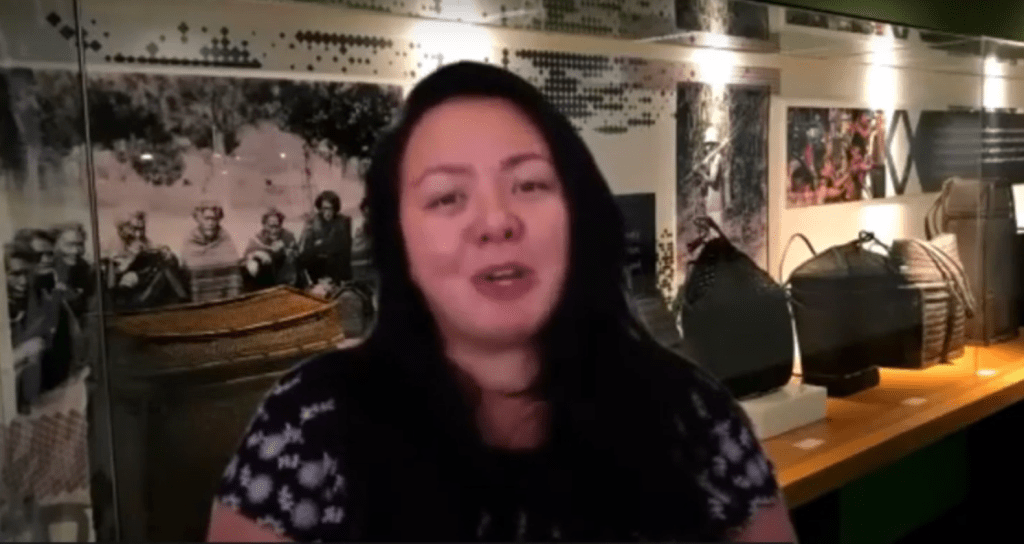
Kath Eustaquio-Derla of PaperKat Books, with her depth of experience in their own family business, discussed the importance of legal know-how when planning to publish. She opined: “These are the things that you should know to avoid legal problems in the future. But if you want to consult a legal lawyer, feel free to do so. This process is based on my experience from my own business.” Derla heads the publishing arm of PaperKat books and StoryFactory, which covers books to film/TV adaptations.

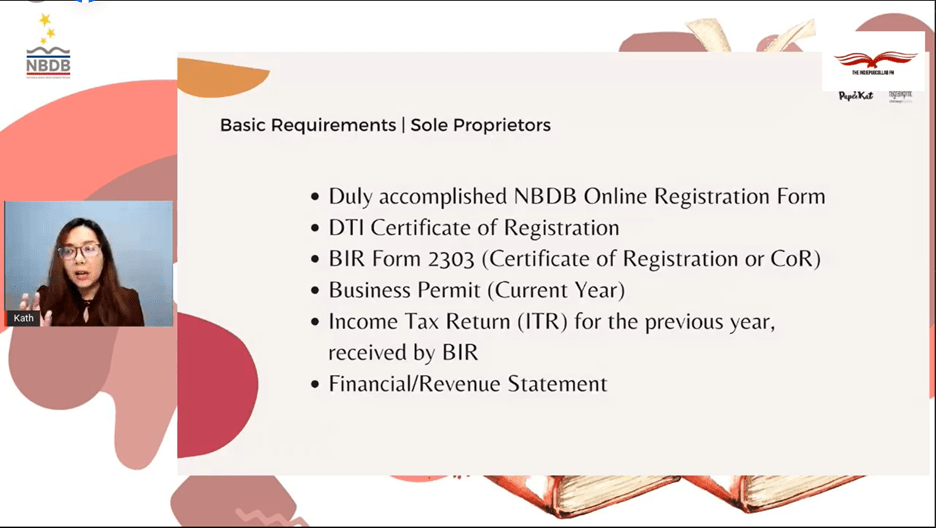
Derla stressed the importance of taking advantage of the now more refined and streamlined registration process. “Now everything is done online. Before, everything was done manually.” She discussed how to register as a sole-proprietorship, a partnership or a corporation. She also discussed the necessary requirements before completing the registration for NBDB (website linked here), as well as what needs to be properly declared in the forms. She also clarified the common misconception that publishers need to print their own books. “Printing is different from publishing. You can be a publisher without your own printing press. For example, we started out as a publisher with no printing equipment.”

In summary, an aspiring publisher needs to acquire a DTI Business Name Registration, a BIR 2303 Certificate of Registration ( for publishing and printing activities), and a Business Permit (Mayor’s Permit).
Another critical component of publishing is applying for an ISBN. As Derla mentions, “ISBN is a serious matter. As a publisher, we need to protect the works of our authors. Whenever we launch a book, our authors have the confidence to face anyone because we followed proper documentation.” Derla again applauded the ease of applying for ISBNs now that it can be done online (via this link), and shared how their company was invited as part of the beta program for this initiative.

Derla also discussed the importance of Cataloging in Publication (CIP). A service offered for free by NLP, its purpose is to produce standardized bibliographic descriptions for forthcoming Philippine publications. She also discussed the advantages of opting for legal deposits for books, as this will help spread the footprint of books, which is especially beneficial for independent writers from smaller publications.

In closing, Derla reminded everyone that following the legalities of being a publisher is only half the battle, as success will ultimately boil down to marketing and skills. “Self-publishing is a business. Carry yourself as a brand. You are your own brand and you are your own business as a self-publishing author.”

The Current and Future State of Indie

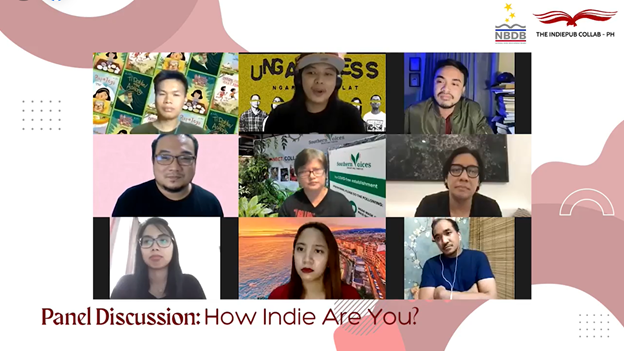
The rise of indie in the Philippines has always been centered around the concept of community. In this special roundtable, How Indie Are You?, the panelists discuss the rise of indie publishing and its current trajectory. Attending the roundtable discussion are MJ Cagumbay Tumamac (Xi Zuq) of Aklat Alamid, Sarge Lacuesta of Good Intentions, Pia Perez of Southern Voices, Noel G. de Leon of Kasingkasing Press, Cindy Wong-Cortez of 8Letters, Christian De Jesus of UNGAZ PRESS, and Ronald Verzo of Balangay Books.

The Rise

The panelists generally agree that the purpose of independent publishing is to build a bridge between the mainstream and the local communities. As Noel de Leon of Kasingkasing press noted: “Indie is rooted sa community. Nagtatrabaho tayo sa loob ng komunidad na alam nating nangangailangan. Madalas nanggagaling sa sariling bulsa ng manunulat at publisher ang paglilimbag ng libro. Ang pinakamahalaga ay dapat sila ay may kawsa..nagtutulong-tulong lahat dahil sa isang paniniwala na madalas ay galing sa marginalized sector ng lipunan.”

Sarge Lacuesta of Good Intentions added that he got into indie because wanted to publish what he wanted to read. “Gusto kong ilabas kung ano ang gusto kong basahin. Gusto kong ibalik ang authorism or yung voice ng creator sa publishing. Tama ang time now to take advantage of new ways of building a platform, distribution and monetization.”

This new “platform” pertains not only to new digital forms of media but also to independent publications that publish books that are not seen in traditional publications because of their perceived “lack of potential to sell,” as well as publishing books to a specific audience. As Noel Verzo of Balangay Books puts it, “The [m]ode of distribution is different [for independent publishers). Independent publishers publish works that are not usally seen in traditional publishers.”
The panelists also discussed the many advantages of independent publishing that simply cannot be replicated when working with traditional publication houses. Pia Perez of Southern Voices opined: “Indie publishers have special relationships with authors. Hindi nila tinitingnan na produkto ang author…ang mahalaga sa indie publisher ay kakaiba ang boses ng author na kailangan bigyan ng puwang. Hindi mahalaga kung magiging mabenta, ang mahalaga ay gustong-gusto namin [ang akda].” Furthermore, Verzo adds:

“Nagsimula kami na ang konspeto ng libro ay ikaw na magulang o guro ay tuturuan namin kung paano magsulat. Ang pagsusulat ng libro ay hindi dapat idinidikta ng mga malalaking institusyon. Hindi kailangang maghintay upang makapagsulat ng librong dapat mabasa.”

The role of independent publishing in creating a space for marginalized communities is something that the panelists also discussed extensively. Noel de Leon talked about how, through his indie efforts, they managed to bring books to far-flung places with no concept of a bookstore. “It impacts the landscapes in the publishing community. Ang workshops ay dinadala sa mga lugar na walang access sa workshop. We have book fairs, zines at chapbook initiatives sa communities. It creates avenues and opportunities for them.”

In addition, MJ Tumamac of Aklat Alamid shared that allowing marginalized communities to publish independently entails cultural preservation, as their cultural works are not usually recognized by mainstream publishers. “Kinikilala natin kung paano lumilikha ng sining ang mga marginalized communities na hindi nire-recognize ng mainstream.” Christian de Jesus of UNGAZ PRESS also shares the same opinion

“Mabibigyan ng recognition or platform ang mga manunulat at kwento ng mga community. Alternatibong plataporma upang maibahagi ang kanilang mga danas gamit ang panulat. Suportahan ang skills ng mga batang gustong magsulat sa kanilang community.”

What’s in store for Indie?

The panelists agreed that indie is here to stay, and the fact that indie publishers survived and even proliferated throughout the pandemic means that there is a market and purpose for the cause. Pia Perez compared the landscape of publishing in general to boats traversing the sea:

“Kung ang publishing ay isang dagat at ang pandemya ay isang tsunami, ang mga indie publishers ay maliliit na bangka na mabilis umiwas sa epekto nito. Ang indie publishers ang sinasabi niya ay hindi na pwede ang same old; kailangan natin mag-chart ng bagong pamamaraan at maghanap ng mga hindi tradisyonal na mambabasa, na naghahanap din ng bagong mensahe.”

The panelists also mentioned the importance of banding together as smaller, indie publishers, as it helps facilitate free exchange of best practices and ideas that help them survive as businesses. Cindy Wong of 8Letters shared the advantages of having a group like TIPC as well as holding INDIEPUBCON 2021 as an event for indie writers and publishers:

“Nagkakaroon ng fresh ideas sa weekly meetings at nalalaman ng ibang miyembro. Nagkakaroon ng connections sa National Library, NBDB at pagsali sa book fairs atbp. Ang plano sa hinaharap ay mas “makabenta” ang maliliit na publishing company ng libro para mas maging sustainable tayo sa pandemic. Naging mas madali para sa miyembro dahil may napagtatanungan, koneksyon at ideya kung paano payayabungin ang independent publishing.” Furthermore, Ronald Verzo adds:

“Ang idea kaya binuo ang INDIEPUBCON 2021 ay para makipag-tulungan sa isa’t-isa. Tayo ang pinaka-vulnerable mawala agad. Mas makakatulong ito sa atin if we exchange ideas and help each other out. Nagsasama-sama rin tayo dahil alam natin na kailangan nandito tayo; meron tayo sense of purpose, hindi lang basta makapag-limbag ng libro.”

Finally, the panelists advised aspiring indie publishers about what they need to know before getting into the business. Noel de Leon mentioned that while indie publishers can survive independently, real progress will only come with help from policy changes and the government.

“Huwag tayong matakot i-assert ang ating karapatan. Hangga’t walang malinaw na polisiya na po-protekta satin bilang maliliit na publishers, patuloy lang na maguusap-usap tayo, kaya’t kailangan natin i-assert and ating karaptan sa gobyerno.”

Cindy Wong also mentions the importance of understanding that indie publishing is also a business and cannot just focus on advocacy. “Always put community at the center when you are supporting an indie publishing business. Importante pa din na mapag-aralan at maging sustainable, may paraan para hindi maging “struggling artist,” pag-aralan at mag-explore ng ibang platforms. Posible na kumita tayo na we cut off the middle person.”

In closing, Ronald Verzo stressed that the goal of independent publishing is to ultimately make a difference in the community. “Alamin kung bakit may pangangailangan. Alamin kung paano matutugunan kasi ito ang bagay na lagi mong babalik-balikan. Pagyamanin ang mga tao na kasama mo, katulad ng paglilimbag sa printing press sa iyong komunidad. Maghanap ng tao who shares the same vision.”

“Respetuhin ang manunulat at mambabasang Pilipino.”

This event is made possible by the National Book Development Board. Vox Populi PH is the official media partner for INDIEPUBCON 2021.

INDIEPUBCON2021 Day 1: Defining and Defending Publishers and Writers

The first day of the first-ever INDIEPUBCON kicked off Friday afternoon, thanks to the combined efforts of The Independent Publishers Collab-PH (TIPC-PH) and the National Book Development Board. INDIEPUBCON 2021 is a five-day event featuring many discussions about writing and publishing that are not readily available to the public.

NBDB’s Executive Director, Charisse Aquino-Tugade, graced the opening program, inviting creatives (illustrators, authors, editors, and publishers alike) to register at the NBDB for free, to avail of grants and other special benefits.

Against Militarism, Sailing Toward Freedom 

The first part of the program featured lively presentations from independent publishers and timely promotions of titles worth reading from the indie publishing scene. Balangay Media Productions (presented by Ronald Verzo) emphasized the need to create a new balangay that is “not just a symbol, nor a memory,” and that “[we wager] with this balangay, that we know our seas and coasts better,” and by sailing freely, we regain our independence. TIPC-PH also released a statement on the ban on subversive books in some state university libraries, stating that the needless, militaristic mindset that affects the world of books and ideas should be firmly opposed. 

Keynote Speech: Nida Ramirez of Avenida Publishing 

This year’s keynote speaker is Nida Ramirez of Avenida Publishing, who gave a thorough unpacking of what it means to be a publisher. The richness of her life experiences in publishing genuinely set the theme of what’s to come at INDIEPUBCON. She began her speech by saying that what she wanted to share was not an ideal or inspirational story containing a definite success roadmap, as she didn’t plan to become a publisher (in the beginning).

“[Publishing] came about as the answer to a need–specifically of my boss, who asked me what we could do so that our printing presses will always have something to do, mainly because our work was (kind of) seasonal. This was in 2000. At that time, I was already a huge fan of the Bobong Pinoy website. Bob Ong told me that he wanted to put out books. What my boss really wanted was a magazine that we could produce monthly or weekly. His peg was Reader’s Digest. I cannot handle that kind of headache.

“So, I said, okay this is just right, we can try one book and if we got good results from this one, we can try another one. If it fails, well, the losses won’t be substantial, either. Personally, it was a win-win solution, because at the same time, I would be able to work with my idol. And the rest, as they say, is history,” said Nida.

A Special Message from VP Leni Robredo 

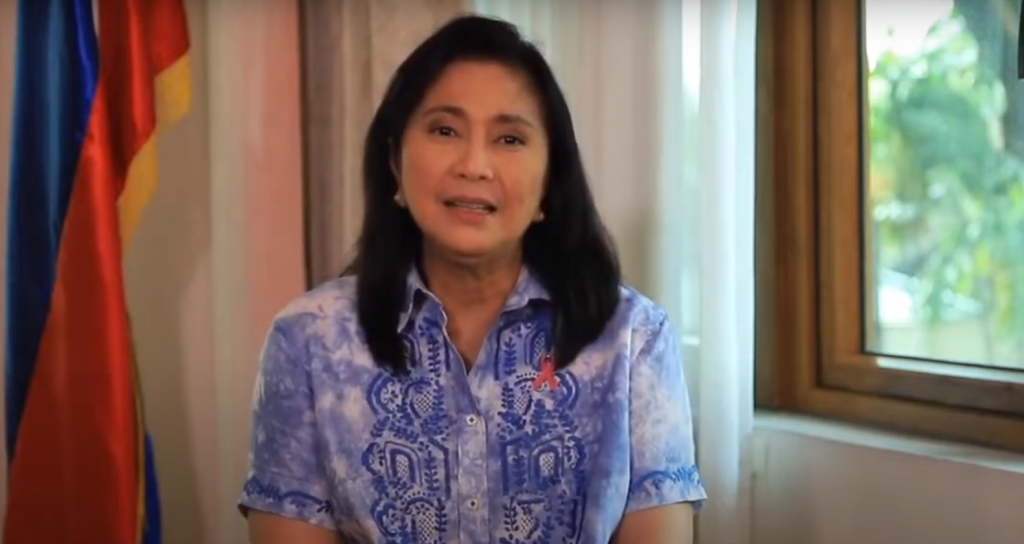
Vice President Leni Robredo sent a special message to this year’s INDIEPUBCON. VP Robredo’s message focused on the essential connections between creative work, publishing, and uplifting the marginalized. She commended the organizers for persevering through challenging times and taking the initiative to organize this year’s event specifically for independent publishers.

“As you launch your conference, you are probably thinking–how can we assure the support needed by indie publishers, especially in the time of the pandemic? How can we further enrich our advocacies in publishing? Many fear what tomorrow brings, and as we give life to these experiences: anxiety, fear, and uncertainty, we can bring what’s in the heart outward–to our kapwa.

“We become conscious that we are not alone in our experiences. Our language and writings express what it means to have a bayan. And in our grief and exaltations, we bring the threads of what makes us Filipinos ever brighter. 

“We are all connected. Thus, my clarion call is to continue mirroring the Filipino experience in every book that we publish. The entire spectrum of how we live/feel, from suffering to victory, from disappointment to hope–in these ways, our sense of nation-ness deepens even more.

“In the face of the pandemic, as we continue to strengthen and enrich our languages, let us also share knowledge and wisdom that will help raise our communities. Let us continue deepening our relations with one another. Widen the net of compassion. Make the voices of the marginalized ever louder and clearer, especially our katutubo, so that many more can hear them,” said VP Robredo.

Warm Welcome Messages from V. Almario & E. Abueg 

This year’s INDIEPUBCON received special messages from National Artist Virgilio Almario and renowned foundation of Filipino literature, Efren Abueg. Virgilio Almario said that he personally believes that independent publishers in the Philippines had a special place in the scheme of things. He continued his message by saying that the publishing scene should not be monopolized by the big publishers, and the indie publishers are there to help create new markets for never-before-seen books.

Efren Abueg left a heart-warming message to independent publishers and readers alike, saying that he was astounded that such an event was possible in the middle of the pandemic. He also shared a bit of his history with independent publishing, saying that in his time, he was not able to carry out certain research efforts and writing, believing that no publisher will ever take interest in such works.

“I have the deepest respect for your commitment in advancing Filipino literature, which up to now suffers from scarcity of translation even in ASEAN languages, and there is even less presence in renowned, global languages.

“Let me share with you my earliest experiences as an editor who wanted to have his collection of works published. It was difficult, to say the least, to engage with individual writers, and it was even harder to find a publisher who would be willing to risk it for my earliest efforts to get published. I was a student then, in 1959 who was “challenged” to publish my first anthology,” said Abueg.

The Jun Cruz Reyes Roundtable 

Day one of INDIEPUBCON 2021 also saw the successful meeting of minds in the Jun Cruz Reyes Roundtable, Pagbali sa Utos ng Hari: Malayang Paglalathala bilang Dayalogo Kontra-Gahum. The roundtable was moderated by Rebo Press Book Publishing’s founder and Vox Populi PH’s editor-in-chief, Maria Kristelle Jimenez and was headlined by Jun Cruz Reyes, Allan Derain, Natalya Patolot and Ronaldo Vivo, Jr. Marius Carlos, Jr. from Vox Populi PH presented excerpts from the seminal Utos ng Hari in a special read-aloud session. The event was streamed live via Streamyard on TIPC-PH’s Facebook page

Jun Cruz Reyes highlighted that Utos ng Hari was not anti-teacher, but was rather anti-anti-freedom of expression and anti-Marcos teachers, as the teachers that he referred to in the story were Marcos supporters who stifled students, erased votes and forced students to sing Bagong Lipunan.

Jun Cruz Reyes began the roundtable with a special lecture, where he highlighted several crucial points about writing and publishing in the Philippines. His first point was about “anti-establishment writers who joined all the contests and all the awards” and “anti-establishment writers who want to sell a lot of books, and in the end, become sell-outs.”

Excerpts from the lecture follow:

“Are we happy when a book has been printed 1000 times, which takes twenty years to sell? Are we really happy [with these figures], as we have a voting population of 54 million? We can’t have writers without publishers. 

“These two are connected. And there can never be writers if there are no readers. We seem to be forgetting something important in the discussion how will the writer earn from writing? When you publish a book, the printer, the binder and all of these people make money–the only one who doesn’t clearly earn is the writer.

“There are large and ready markets–what is to be done? Do we become cooperatives? Do we bind together as associations like publishers’ associations? Then there’s the NBDB. I don’t know if it’s just missed or forgotten, but independent publishers give a huge help to the effort, when you combine these [independent publishers]. I think there should be an effort to establish a healthy relationship between the writer, reader and publisher,” said Reyes.

One of the critical questions in the roundtable was “what is the history and meaning of indie publishing?” Allan Derain, author of Aswanglaut and representative of the Ateneo Institute of Literary Arts and Practices (AILAP), provided insights on the scarcity of written histories on literary production.

“First of all–do we want to talk about history in its most technical sense, or do we want to talk about history by way of looking at it as recorded narratives? We can look at history as a narrative that wasn’t just told to another person/people but a narrative that was written down. If someone would ask me about history, top of my head, there would be Bienvenido Lumbera, then there is also a sustained work by Resil Mojares, then Soledad Reyes. Then there’s one that I know of, a book historian, who watches over the history of books in the Philippines, Mae Jurilla.

“Unfortunately, I think no one is really writing about the history of publishing and all the things related to literary production. We don’t have a history of indie [publishing] because we don’t have a history of publishing [in a general sense].

Natalya Patolot, a young writer from the Ateneo De Manila University enriched the roundtable with her question on legitimacy as a young writer–should young writers first be published by “reputable publishing houses, preferably academic ones” and aspire for at least one award to be considered writers? Jun Cruz Reyes has a pointed response: “there is no wrong [way] of writing. Write and write. The critic comes last–you do not write for the category [of the critic].”

Ronaldo Vivo, Jr. of Ungaz Press shared his insights on what it meant to be a writer in this day and age.

“There is no board exam for writers. A dancer, if he wants to dance, can dance without an audience–and he is called a dancer after. In my perspective, I think a writer is similar. If you can write, even if you don’t have any validation from the authorities [that we know of], you are a writer. It’s that simple,” sad Vivo.

When asked about how he’s carrying out the work of presenting alternative works to the classroom, Allan Derain said that he engages students in dialogue so that they may think of other works that may serve as an alternative to his syllabus.

“I am fortunate to be in an institution that is somewhat open to these things. Our course is a survey of literature [its entire history]. I always make it a point to open their minds to the concept of canon and our course becomes reflexive in this sense, as there are many types of canon. So when they’re done with my syllabus, our final project would be–what alternative syllabus can you offer?”

The roundtable continued for almost two hours, extending to many other dimensions of independent publishing and writing in the Global South. 

This event is made possible by the National Book Development Board. Vox Populi PH is the official media partner for INDIEPUBCON 2021.

INDIEPUBCON 2021 Day 1: Nida Ramirez’s Message

INDIEPUBCON 2021 is a five-day event featuring many discussions about writing and publishing that are not readily available to the public. This year’s keynote speaker is Nida Ramirez of Avenida Publishing, who gave a thorough unpacking of what it means to be a publisher.

The richness of her life experiences in publishing genuinely set the theme of what’s to come at INDIEPUBCON. Below is the transcript of her 11-minute speech during the first day of the INDIEPUBCON 2021.


Magandang araw ng Biyernes po sa inyong lahat. Isang napakalaking karangalan para sa akin na magbigay ng keynote speech para sa pagbubukas ng INDIEPUBCON 2021. Uunahin ko na ang isang masigabong pagbati sa mga organizers at sa mga kasaping indie publishers. Nakakabilib at talagang very inspiring ang mga nagagawa at magagawa pa ng TIPC, The Indie Publishers Collab Philippines. Napakagandang patunay ito na malayo ang nararating kapag nagbubuklod at nagkakaisa. 

First time ko pong magdeliver ng speech, tapos keynote pa. Kaya nagpatulong ako kay Ronald Verzo ng Balangay kung ano ba dapat ang mga sasabihin ko. Ikuwento ko raw ang pagsisimula ko sa publishing, para magsilbing guide at inspirasyon sa mga kasaping independent publishers ng TIPC.

Sa totoo ay laging naiilang akong ikuwento ang pagsisimula ko sa publishing. Hindi naman kasi ito kuwento ng “pangarap na natupad”, o successful business story na may “ideal roadmap”, o yung mga tipong pang-business seminar. 

Una na kasi, hindi ko naman talagang pinlano na maging publisher. Dala lang lahat ng pangangailangan. Ito ang naisip kong isa sa mga pwedeng solusyon sa tanong ng boss ko dati kung ano ang pwedeng gawin para tuloy-tuloy ang takbo ng mga makina ng imprenta, lalo pa at may pagka-seasonal ang mga trabaho namin. This was in 2000. That time, fan na fan naman ako ng Bobongpinoy website, at sinabi ni Bob Ong na gusto niyang maglabas ng libro. Ang talagang gustong ipagawa sa akin ng boss ko ay magazine na monthly, or weekly. Ang peg niya ay Reader’s Digest. Naku, di ko keri ang ganung kalaking sakit ng ulo! Kaya sabi ko sa kanila, tamang-tama na “sumubok” muna kami sa isang libro. At kapag ok ang naging resulta nito, gumawa ulit ng pangalawa; kung hindi naman ok, at least, di rin ganun kalaki ang magiging talo. Personally, win-win solution ito para sa akin, dahil at the same time, makakatrabaho ko ang idol ko. And the rest, as they say, is history.

Pangalawa (dahil may una kanina), hindi rin kasi ako ang tipo ng tao na mahilig magplano ng future niya. I either live the day, kapag ok ang mundo; or try to get through the day, kapag di gaanong matino. I deal with things as they come. I enjoy discovering things along the way, making mistakes, and learning from them. Hindi ko rin pangarap maging mayaman, maging Jack Ma, or magkaroon ng Fortune 100 company.

So gets niyo na kung bakit hindi ideal na pang-speech ang mga kuwento ng pagsisimula ko. Kumabaga sa manuscript proposal, hindi ito “marketable”, hindi “relatable” o “inspiring” man lang ang kuwento.

At dahil diyan, I will just share what I think are the principles or life lessons that worked for me in my publishing journey. Kapag may mga desisyong kailangang gawin o komplikadong problemang dapat ayusin, ang mga gabay na ito ang binabalikan ko. Hindi man sila exact solution, lagi at laging nakatutulong sila para gawing mas malinaw ang daan na dapat piliin.

Una na ang: there is no single way of doing something. 

Bilang independent publisher, we tend to follow the “standard” set by our predecessors or the big publishers. At walang masama doon. May mga practices na subok nang epektibo. But at the same time, may mga sistema ding patuloy na nagbabago depende sa takbo ng mundo. Dapat bang nasa kilalang bookstores ka para maging legitimate author o publisher ka? Dapat bang nasa bestseller list ka nila para maging “made” ka? Dapat bang consignment ka lang palagi sa mga tindahan at maghintay na bayaran ka sa naibenta nila matapos ang tatlo, anim, o walong buwang paghihintay?

Iba na ang panahon ngayon. At ang mga pagbabago ay lalo pang pinaigting ng pinagdadaanan nating pandemya. The pre-covid world is ancient, ika nga. Sa kabila ng maraming pagdurusang dala ang pandemya, marami din itong binuksang opportunities para sa mga publishers gaya natin. Bahagi ng opportunities na ito ay ang pagbibigay sa atin ng lakas to stand on our own, makapagbenta directly sa mga mambabasa, at akuin ang mas malaking kita sa mga libro dahil dito. We are now our own bookstores. The better news is, alam na rin ito ng mga mambabasa. At matapos man ang pandemya, ang sistemang ito ay hindi na mawawala. Tandaan lang na  patuloy tayong makiramdam, maging bukas at wag matakot sa mga pagbabago.

In terms of the types of books we publish, applicable din ito. Wag tayong basta magpakulong sa nakasanayan nang standards sa pag-uri ng mga kuwento. Unang-una sa pamantayan namin dati sa Visprint para sa mga tatanggaping kuwento ay kung nag-enjoy ba kaming basahin itong kuwento tungkol sa mga Pilipino. Regardless of genre, category, o format. May mga nagsabing kakaiba daw ang mga librong inilabas namin. Pero wala naman akong nakikitang kakaiba sa desisyong piliin ang mga librong gugustuhin ding basahin ng ibang tao. Tsaka na lang namin pinroblema kung saang category ba sasakto ang mga libro.

We are in the creative business. Let us be creative and innovative in finding our ways to succeed, in solving our problems, and in our business journey.

Another business principle I hold on to is to always engage in a “mutually beneficial transaction and relationship”. 

Sa totoo, una ko itong nakita sa print costing letter na pinadadala ng Visprint sa mga kliyente nito para sa printing press: “We look forward to a mutually beneficial business relationship with you.” ‘Yan ang closing statement sa lahat ng sulat na ipinadadala. Tila ba pagpapaalala sa magkabilang panig na anuman ang maging transaksyon nila, dapat na pareho silang makinabang. Dapat na may bigayan, walang lamangan. Kapag may mga dapat pagdesisyunan, hindi lang ang pansariling kapakanan ang titingnan. Siguruhing ang tagumpay mo ay hindi ikapapahamak ng kabila. And through the years, the partners we have had the most successful businesses with are those who have been considerate of our situation, and those who we have extended considerations to. Dahil kapag bukas sa pagbibigayan ang dalawang partido, hindi lang kayo magkaramay sa paglutas ng problema, magkasalo din kayo sa tagumpay.

Ngayon sa Avenida, kailangan na naming magpaimprenta ng aming mga libro, di gaya dati sa Visprint na in-house ang printing. Isa ito sa mga bagong proseso na kailangan kong gawin sa pagsasarili ng publishing house. Nakakapanibago, at nakakanerbyos sa umpisa, ang kawalan ng malaking control sa production ng libro.  May ilang imprenta kaming sinubukan, at sa ngayon ay mayroon na rin kaming suki. Hindi sila ang pinakamalaki o may pangalan, pero sila ang nakakuha ng aming tiwala dahil ramdam mo ang concern nila na mapagbuti ang kalidad ng libro. Excited sila kapag may gusto akong bagong subukan o gawin sa libro. Mas madali kasi para sa karamihan na sabihin lang na, “Di namin ginagawa yan” kaysa samahan kami sa paghahanap ng paraan.

Pinaka-applicable ang prinsipyong ito sa mga authors at komikeros na nakakatrabaho namin. Kung wala sila, wala kaming librong gagawin at pagkakakitaan. Walang negosyo. Mahalaga na may tiwala sila sa amin, hindi lang sa kakayahang mabuo at maibenta ang libro nila, kundi ang tiwala na pinapahalagahan namin sila, at kinikilala ang laki ng role, at the same time, ng responsibility nila, sa ugnayang ito. That way, we both exert our best in every book that we publish.

Sakop din nito ang pakikipagtransakyon sa iba’t ibang suppliers, designers, editors at ahensya. Hangga’t kakayanin, we try to give them what is due. Lagi nating ine-aim na maging global ang standard ng mga trabaho natin. Kaakibat ng pagtataas na ito ng kalidad ng ating produkto, kailangang itaas din natin ang respeto at pagkilala sa talent ng mga creative workers natin sa pamamagitan ng pagbabayad ng tama at on time sa kanila.

Kapag ramdam ng lahat ang kahalagahan nila, at ang lahat ay nakikinabang, mas marami tayong mapapagtagumpayan.

At ang pinakahuling pinaniniwalaan kong gabay ay “ok lang magtanong at humingi ng tulong.”

We were made to believe that everyone else with the same business as ours is a competitor. That by asking and seeking help, we become inferior. That helping other publishers will make them better than we are. Or that we’ll lose sales by doing so. Fake news po yan.  It is ok to seek help and to give help. 

Hindi lang iilang beses na may mga sistemang naituwid at naiayos sa ating industriya dahil may isang nagtanong o nagkuwestiyon ng kalakaran. Taxes, government procedure, o malakihang event man. One question will lead to discovering that it is actually a shared concern by most, if not all.  At dahil doon ay nagkaroon ng pagkakaisang tugunan ito at ayusin. Mayroon at mayroong makikinig, sasagot, at tutulong.

Kaya nga ganun na lang ang tiwala ko sa kakayahan ng TIPC na palaguin ang mga independent publishers na kasapi nito. At higit pa rito, sigurado akong dahil sa pagbubuklod na ito, marami kayong mabubuksang mga bagong paraan at kakayahan, mga lumang sistemang maitatama o maiaayon sa pagbabago ng panahon, at maituturo sa mga matagal na at matanda na sa industriya ng publishing. Kayo ang bagong dugong dadaloy at lalong magpapanagana sa mga aklat ng Pilipino. Humayo kayo.

Maraming salamat po sa inyong lahat.

This event is made possible by the National Book Development Board. Vox Populi PH is the official media partner for INDIEPUBCON 2021.

Vox Populi PH Joins CCP’s PPE: Performatura Pandemic Edition 2021

Authors from Vox Populi PH will be reading excerpts from their works in this year’s Performatura Performance Literature Festival. This year’s international PPE: Performatura Pandemic Edition will happen on November 22-24, 2021, from ten o’clock in the morning to ten in the evening. Interested individuals and groups will have access to many much-awaited performances, including Vox Populi PH authors.

This year’s international festival is led by the Festival Director Vim Nadera and Beverly Siy of the CCP Intertextual Division.

Despite the physical constraints of the pandemic, the Cultural Center of the Philippines remains fully committed to bringing the best of our nation’s literature, history, and culture closer to Filipinos. Therefore, Performatura Pandemic Edition will be showcasing poetry readings, spoken word competitions, musical presentations, dance dramas, theatrical shows, and storytelling events. This year’s theme is “Aking Adhika Makita Kang Sakdal Laya.”

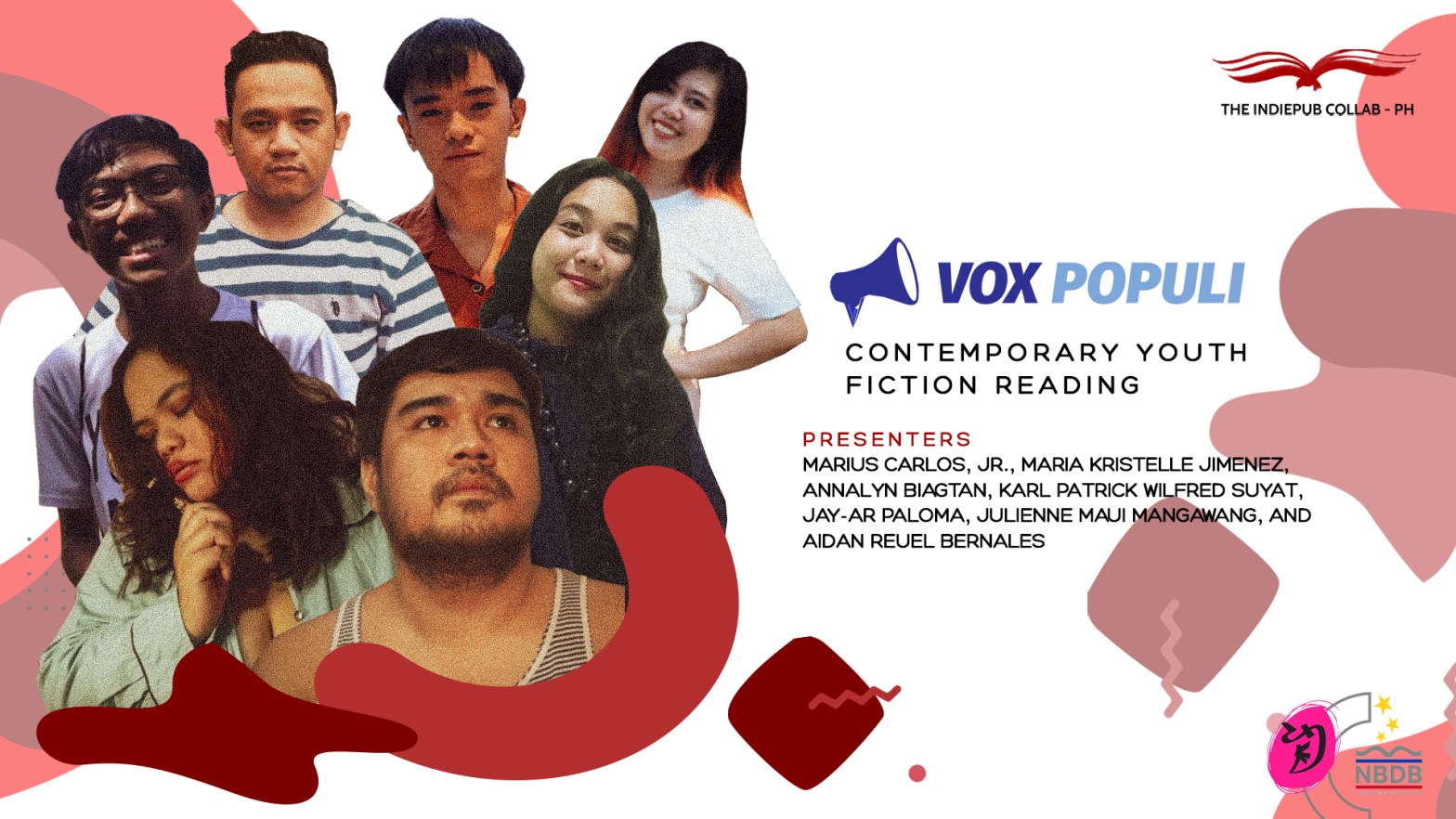
Vox Populi PH final event poster featuring the publication’s suite of young authors.

Vox Populi PH, a youth writing organization with digital and print publication and broadcast arms, has weathered various storms brought by the pandemic and remains firmly committed to bringing the best youth writing in the Philippines to more readers.

Aligned with the organization’s overall aim of nurturing young writers to better function in a landscape that is less than ideal and welcoming to free expression, Vox Populi PH authors shall be holding readings of various works. This year’s participants are Aidan Reuel Bernales (spoken word poetry), Marius Carlos, Jr. (essay reading), Maria Kristelle Jimenez (story reading), Jay-ar Paloma (poetry reading), Annalyn Biagtan (story reading), Julienne Maui Mangawang (poetry reading), and Karl Patrick Wilfred Suyat (essay reading). “Nag-umpisa ang Lahat sa Isang Tinig” will be performed by Rebo Press’ resident graphic artist, Gwynette Ivory Marbella. The books that authors will be reading have also been exhibited at this year’s Frankfurt Book Fair.

Performatura is by no means a stranger to the independent writing and publishing scene. According to the editor-in-chief of Vox Populi PH and Rebo Press founder, Maria Kristelle Jimenez, she first attended Performatura in 2018, where she was welcomed with open arms by Festival Director Vim Nadera and CPP’s Beverly Siy as she helped exhibit several zines by up-and-coming youth writers from that era in her career as a serial indie publisher and organizer. She was told to “keep going” and “hold the line” for young creatives who wanted to learn the craft further and eventually publish in various formats in both print and digital.

This event is made possible by the National Book Development Board. Vox Populi PH is the official media partner for INDIEPUBCON 2021.

Lipad Saranggola: Abutin ang mga Pangarap para sa Batang Mambabasa

INDIEPUBCON 2021 promises to provide a platform to many types of writers, inclusive of many genres and forms of literature. One of these is children’s literature, which is a collection of written works and associated illustrations intended to entertain or educate children. This includes acknowledged world literature classics, picture books and easy-to-read stories written exclusively for children, as well as fairy tales, lullabies, fables, folk songs, and other primarily orally transmitted materials. Children’s literature arose as an unique and independent type of literature for the first time in the second half of the 18th century, and has enjoyed a continuous and steady growth in popularity until today.

Giving children access to a wide range of reading is critical to their success. Children’s literature is important because it allows students to respond to literature. In addition, it teaches students about their own cultural heritage as well as that of others. Children’s literature also  fosters emotional intelligence, creativity, personality and social skills. Moreover, it passes down important cultural themes from one generation to the next.

It is important to understand that the concept of “children’s literature” is a foreign term. The Philippines has long since passed on folklore, lullabies, and different types of literary forms intended for children, but the first titles that we can consider as children’s literature were imported from Europe. A more successful attempt at “filipinizing” the content of beginning reading textbooks was Pepe and Pilar (1930s). Camilo Osias had previously collected stories from all over the world in The Philippine Readers Series (1922-1934), with pictures by Fernando Amorsolo. The Osias Readers, like Pepe and Pilar, were well-liked in schools across the country. They were textbooks, after all, with the primary goal of instruction rather than entertainment, and they had limited life outside of the classroom.

While the growth in children’s literature has been steady, there is still a dearth of works written in languages aside from English and Filipino. A movement to make Filipino children’s literature more inclusive means that children from all regions, not just those from the capital, need to have access to books written specifically for them, with the language and nuances they can understand and relate to.

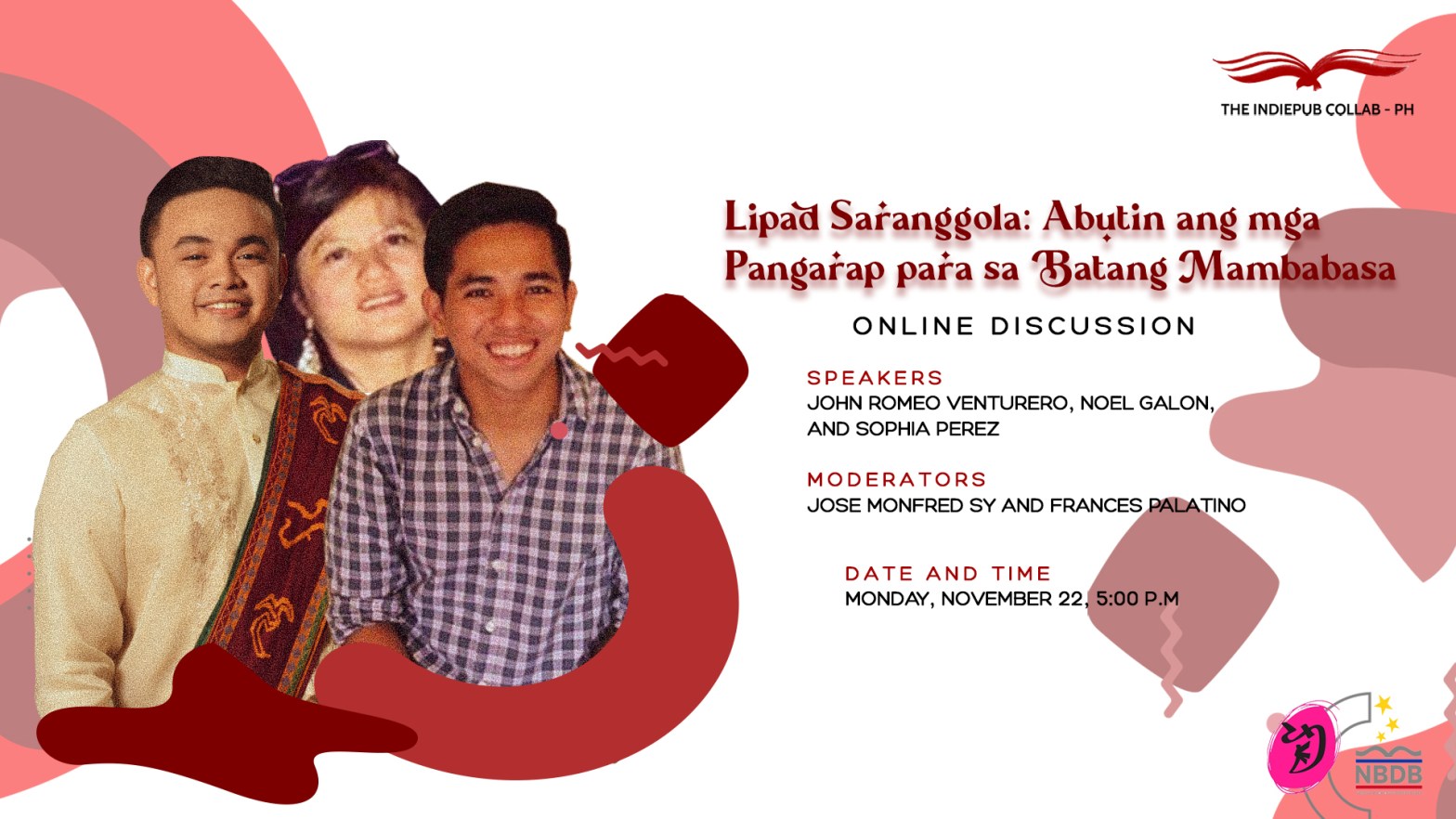
In this panel discussion, John Romeo Venturero of Aklat Alamid, Noel Galon of Kasingkasing Press, and Sophia Perez of Southern Voice Printing Press will share their goals, experiences, and plans in producing books for children and communities that are often overlooked by mainstream publishers. Jose Monfred Sy, a children’s writer, and Frances Palatino, a children’s rights advocate, will moderate the panel.

“Lipad Saranggola: Abutin ang mga Pangarap para sa Batang Mambabasa” will be a recorded discussion and can be viewed via TIPC-PH’s Facebook Page and YouTube channel on Monday, November 22, at 7:00 p.m. The event will be followed by a Q&A portion, and is expected to be a lively and insightful meeting-of-the-minds between indie professionals and aspirants.

Anyone interested to join the forum can read about the registration process here.

This event is made possible by the National Book Development Board. Vox Populi PH is the official media partner for INDIEPUBCON 2021.

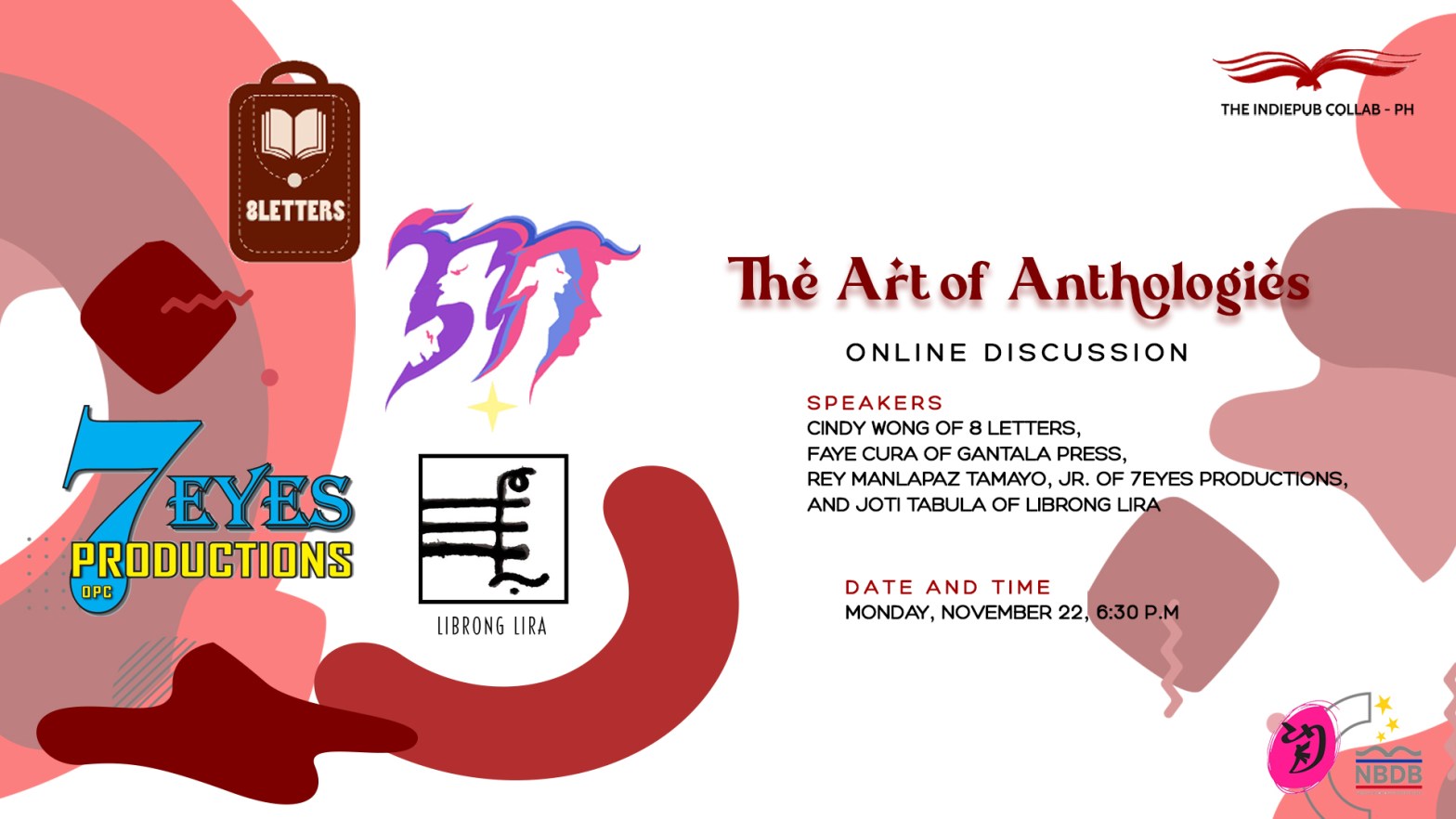
The Art of Anthologies

Anthologies tend to be a peculiar literary genre. Individual texts are already complex, having been produced in different eras by the other writers with sometimes wildly different milieus, social classes, ideologies, and so on.

Take the complexity of the individual work and compile several of them in a singular entity—a book. As a result, you have an even more complex literary organism—moving and growing at various paces and expanding different histoires. Necessarily, the anthology must be viewed with a critical lens. Consumers of collections often have preconceptions about what they can expect from the books they buy—perhaps it’s the title, or the editors, or sometimes expectations are also made based on who is publishing what in the first place. Like other literary genres, Anthologies are experiencing a considerable transformation nowadays in terms of production, distribution, and consumption.

With the ever-widening gyre of mobile, transnational capital transforming communities, sectors, and industries and the undeniable dominance of empire and global capitalism, how do all these power structures affect the act of anthologizing in the Philippines?

As the Philippines is part of the impoverished Global South, it is critical for independent publishers, authors, and other creatives involved in the conceptualization and creation of literary works to create varied spaces for dialogue and unpacking of the most critical aspects of this cultural work, for the sake of readers and vulnerable sectors, and more importantly, in the name of justice and the transformation of the nation.

INDIEPUBCON 2021 will help shed light on how anthologies are collected, edited, and eventually formed into more or less cohesive compilations of individual works.

This year’s discussion is led by Joti Tabula (Librong LIRA), 7 Eyes (Rey Manlapaz Tamayo Jr.), Faye Cura (Gantala Press), and Cindy Wong (8Letters). According to the panel, “anthologies bring writers together,” they shall be talking about how to write/form a successful anthology, the mistakes that publishers and writers should avoid, and how to publish successful anthologies.

Cindy Wong of 8Letters will lightly touch upon the marketability of anthologies, the pros and cons of making and selling anthologies, and other concerns on the business side of anthologizing.

Faye Cura of Gantala Press will be focusing on more important matters that have an essential impact on authors, readers, and the longer-term historical track of anthologies. Among the issues to be explored in Gantala Press’ discussion is the articulation of the individual subjects of anthologies, identifying the purpose of why an individual or group may want to create an anthology (as anthologies are ideological artifacts), and working to ensure representation of women who do not necessarily think or call themselves writers such as farmers, workers and members of the urban poor, lesbians and indigenous women.

Rey Manlapaz Tamayo, Jr. from 7Eyes Productions will be talking about their work in anthologizing and how natural disasters and other events inspire the creation of their books. Rey also shares how to create a process for collecting pieces from writers to create anthologies.

The Art of Anthologies will be premiering on November 22, 2021 (Monday), starting from 6:30 p.m.

This event is made possible by the National Book Development Board. Vox Populi PH is the official media partner for INDIEPUBCON 2021.

The Journey from Being a Writer to a Publisher

Writing is not a job. As with all creative endeavors that demand dedication and sacrifice for the craft, writing is more of a vocation. Writers have  to overcome writer’s block, lack of creativity, isolation and lack of confidence, and even financial and health problems (that starving writer trope is there for a reason). Making it as a writer takes the right combination of talent, grit, opportunity, and a bit of luck.

While most writers succeed by taking the usual commercial publishing route, independent publishing has become more popular in recent years as it provides unique advantages. Independent publishers, in contrast to commercial publishers, are interested in something different. They make their own decisions based on quality rather than profit. They have complete control over all decisions and are not bound by any rules. They don’t publish what people think is popular; instead, they publish what they believe in.

For first-time authors, assistance with marketing and sales is critical. Independent publishers still allow authors to have flexibility and autonomy, and they have the added advantage of having someone (with vast knowledge) helping them  through the entire process. Lastly, the wide acceptance of independent publishing is particularly critical for new and upcoming authors. Many publishing houses have a following or reputation, which means authors will have an advantage when their book is out.

Knowing the benefits stated above, it is no wonder that some writers take the natural trajectory from writing to publishing. The rise of “author-publishers” is not unsurprising as having been a writer means that, as publishers, they understand that they are the brand and their books are a product of that brand. They understand that book publishing is so much more than publishing a book, and are therefore empowered to leverage authorship to its highest potential, unconstrained by publishing houses.

In contrast to traditional publishing, creative ideas and targeted activities enable independent publishers to not only skip the opportunity queue, but also to lead the way and fully own their success stories because they are not required to wait in line. Collaboration has a big potential for authors and publishers, and it is a fundamental component of becoming visible to a larger market. They provide individuals with whom they interact not only exceptional writing, but also the opportunity to establish a large, engaged audience.

For this panel discussion, guest speakers will talk about their experiences from becoming a writer to publishing independently. Guest speakers include Edgar Samar, Palanca award-winning author of the Janus Silang books; and Katrina Olan, local bestselling indie author of Tablay.

“The Journey from Being a Writer to a Publisher” will be a recorded discussion and can be viewed via TIPC-PH’s Facebook Page and YouTube channel on Sunday, November 21, at 7:00 p.m. 

Anyone interested to join the forum can read about the registration process here.

This event is made possible by the National Book Development Board. Vox Populi PH is the official media partner for INDIEPUBCON 2021.

TIPC-PH joins CCP Intertextual Division’s Performatura 2021

The Indie Publishers Collab-PH (TIPC-PH) is a collective of independent publishers sharing the exact track of expanding the literary horizons of the ‘indie’ community in the Philippines. In this year’s Performatura, TIPC-PH will conduct several book launches and a series of storytelling performances.

The Cultural Center of the Philippines brings back the Performatura: International Performance Literature Festival on November 22 to 24. Performers, poets, art conversations with chanters from the regions, book debates, slam poetry contest, book fair and interviews with prominent writers will be part of this virtual event.

“Claiming Indie Spaces in Challenging Times,” the theme of this year’s online convention, is an attempt to expand the literary horizons of the independent publishing community in the Philippines.

The said Performatura event will be on Tuesday, November 23. Publications that will conduct book launches include Aklat Alamid, Alubat Publishing, 8Letters, Librong LIRA, Rebo Press Book Publishing, and Southern Voices Printing Press. 

Alubat Publishing will showcase excerpt readings of Dr. Louie Mar Gangcuangco’s HIV novel “Orosa-Nakpil, Malate.” In addition, Librong LIRA will have performances of Nick Pichay’s poems from his republished poetry collection “Ang Lunes na Mahirap Bunuin.” 

8Letters will launch its newest anthologies, “Takipsilim” and “Hatinggabi,” featuring Philippine mythological creatures, through storytelling. Furthermore, Rebo Press will have an excerpt reading from Frank G. Rivera’s “Si Jose Rizal sa (Loob at Labas ng Kagila-gilalas na) Daigdig ni Atô,” Karl de Mesa’s “Calling Out the Destruction: Collected Non-Fiction Meditations on Violence and Transcendence,” and Vox Populi PH’s excerpt reading from their newest collection of contemporary youth literature.

Southern Voices Printing Press (SVPP) features the launch of “Mga Munting Babae,” the Filipino translated version of “Little Women” by Louisa May Alcott, with actress and model Ms. Mylene Dizon’s participation and former Representative Emmi de Jesus of Gabriela Women’s Party, reading excerpts from the book. Moreover,  Prof. Rowena Festin, who translated the book with SVPP publisher Sophia Perez, gives a brief insight on language and translation.

Aklat Alamid will present read-aloud of its newly released picture books, “Dako nga Yahong sang Batchoy” (A Big Bowl of Batchoy) by Jennie Arado and Rayah Dizon-Maniago, “Ditoy, Isdi, Idiay, Isna” (Here, There, There, Here) by Heather Ann F. Pulido and Renz Juno Abreu, and “Paborito nga Duag ni Denden” (Denden’s Favorite Color) by Early Sol A. Gadong and Gil S. Montinola. The read-aloud will be in the languages of the books—Hiligaynon, Ilokano, and Kankanaey—with subtitles in Filipino.

In accordance with the CCP’s goal of bringing our country’s various cultural traditions, this online event will be open for the public. Additional information could be found in Performatura 2021 official website.

This event is made possible by the National Book Development Board. Vox Populi PH is the official media partner for INDIEPUBCON 2021.

Indie on the Cutting Edge

One of the focuses of INDIEPUBCON 2021 this year is the further transformation of how literature is produced, presented to the public, and consumed privately by individuals. In the years shaped by the pandemic and social distancing, it is challenging to adumbrate the contours of independent publishing, especially if people are unable to meet in large numbers. Common physical distribution channels are discouraged, and consumers are wary of risking physical events as anyone can still get COVID-19.

What has been inspiring in the months that led farther from the first time that the virus landed on our shores are the writers, artists, and creators who found old-new ways to express themselves and, more importantly, publish their works. While the digital spaces are virtually unlimited and there is little standing in the form of pushing out new works of literature, creators and cultural workers still have to create systems that allow them to produce, distribute and reach their intended audiences. This is perhaps one of the more challenging tasks of independent publishers saddled with limited budgets, smaller audiences, and more limited channels for publishing and distribution. Nevertheless, it is enlightening that many cultural workers continue to innovate and shape the answer to “how can we do this” despite these trying times.

Independent publishers, creators, and writers are now also acknowledging the presence of ever-growing digital humanities systems in the Philippines, shaped in part by various forces, structures, and agents in the field. While the concept has always existed, the demand for digital humanities as a purposeful attempt to study literature and art, for instance, in the school setting, was not just emphasized but rushed during the pandemic. 

With partial loss of access to teachers and school facilities, how do people fare with just their smartphones and other digital devices? Did the current circumstances change the reading habits or preferences of people? Many questions need to be answered, and INDIEPUBCON 2021 is only at the beginning of what could be years of exploration to discover how the pandemic has changed how people intrinsically view and consume literature.

Another tangent that INDIEPUBCON 2021 is attempting to touch is that we are a Third World country. The formation of digital humanities necessitates scant and often out of reach in the Philippines—reliable internet, for example, is still a considerable expense and one that is barely affordable if a person were to utilize digital resources for personal schooling consumption fully. There is also the need to address the interactions between publishers, writers and their readers, as well as how the educational system is positioning writers and literature at the same time within the larger structure of learning. 

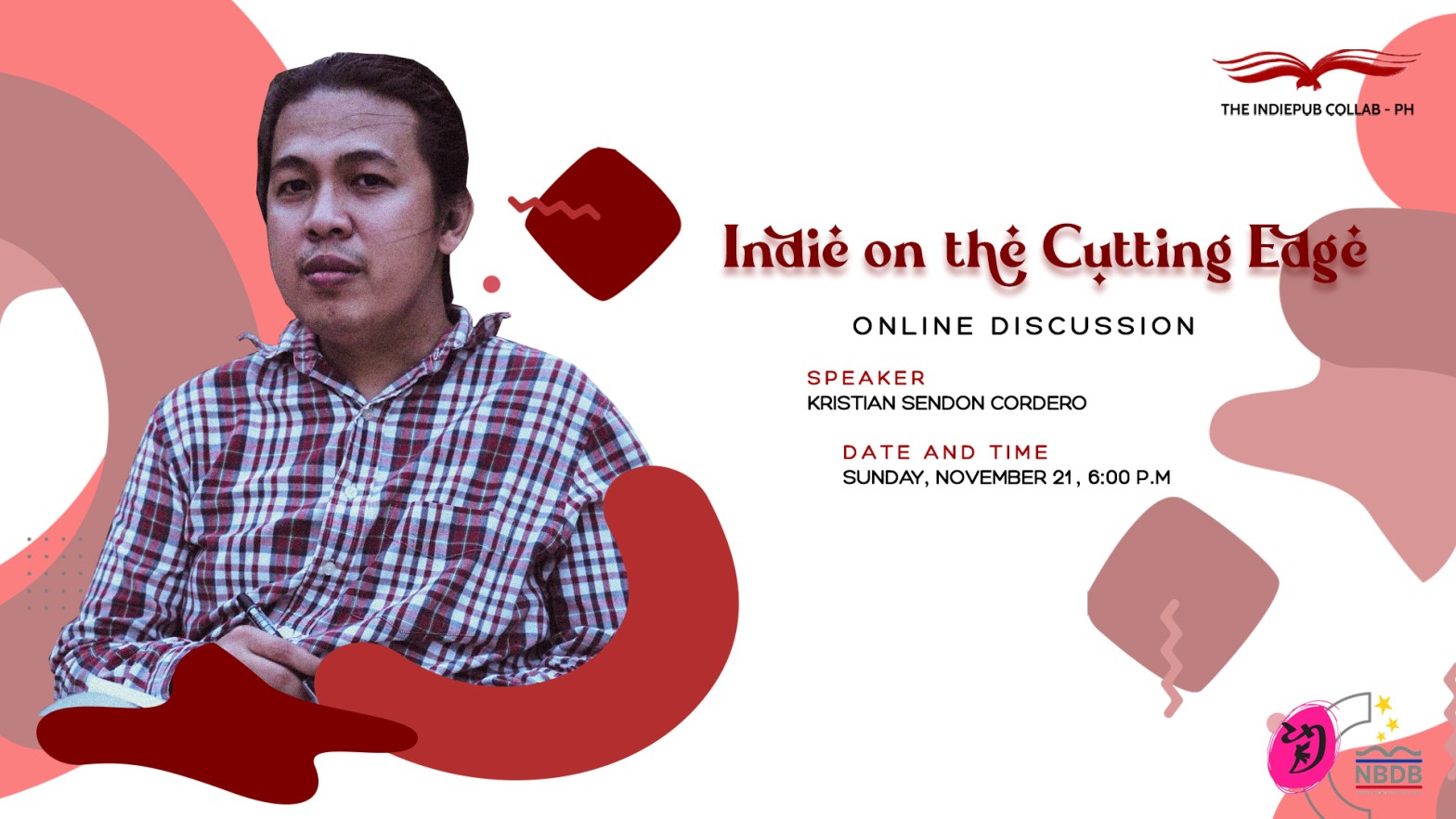
And so the INDIEPUBCON 2021, will be hosting the talk “Indie on the Cutting Edge” with speaker Kristian Cordero of Savage Minds Bookshop. Kristian is a fictionist, filmmaker, translator, and poet based in Bikol. Kristian writes in Filipino, Bikol, and Rinconada and has translated Rilke, Wilde, Kafka, and Borges. His debut volume of poetry in each of his three languages earned the Madrigal-Gonzales Best First Book Award in 2006, and two of his most recent collections received National Book Awards in 2014. He is the Ateneo de Naga University Press’s deputy director. Kristian will be discussing the challenges of independent publishing in Naga in the Bikol region, as well as a new book—Himati—published by the Savage Mind Publishing House, the NCCA and the Ateneo De Naga Press, as it explores the renewed facets of literature, from orality to bringing addressing the needs of newer audiences.

Catch Kristian S. Cordero on Sunday, November 21 at 6:00 p.m. live via TIPC-PH’s Facebook Page and YouTube channel, where he will talk about mainstreaming indie and innovations in indie publishing, especially during the pandemic. 

This event is made possible by the National Book Development Board. Vox Populi PH is the official media partner for INDIEPUBCON 2021.

The Evolution of Indie Publishing: From Physical to Digital Spaces

The importance of independent publishing, and its symbiotic relationship with commercial publishing, cannot be understated. Filling in a niche in the bigger literary space, independent publishing offers services similar to those offered by traditional publishers, but in new and innovative methods. As independent publishers, we put more emphasis on cultivating partnerships with writers, editors, and all stakeholders in the publishing space, as well as fund and oversee the book’s development and promotion. This is all with the goal of providing a platform for the publication of works by other writers.

Independent publishing was born out of a need to expand both creativity and control in the writing and publishing process. In contrast with commercial publishers, independent publishers are generally interested in something niche or different: they make their own decisions based on quality rather than profit or number. They have complete control over all decisions and are largely not bound by any rules. They don’t publish what people think is popular; instead, they publish what they believe in. Looking at these advantages, it is not surprising that we have seen the rise in the number of independent publishers in the past decade.

The rise of the internet age gave birth to the digital space, and consequently the beginning of independent publishing online. The non-physical form made way for several huge advantages: from a faster turnaround time, a more interconnected space of remote writers, and most importantly, the utilization of different types of new media (such as podcasts, videos and the like) as forms of literature. “Indie publishing” has blossomed in the Philippine literary scene, transforming the contemporary landscape of arts and letters. Furthermore, as independent publishers have adapted to the difficult times of the epidemic, the indie community has managed to leave its mark—enough to be recognized, but with much more work to do.

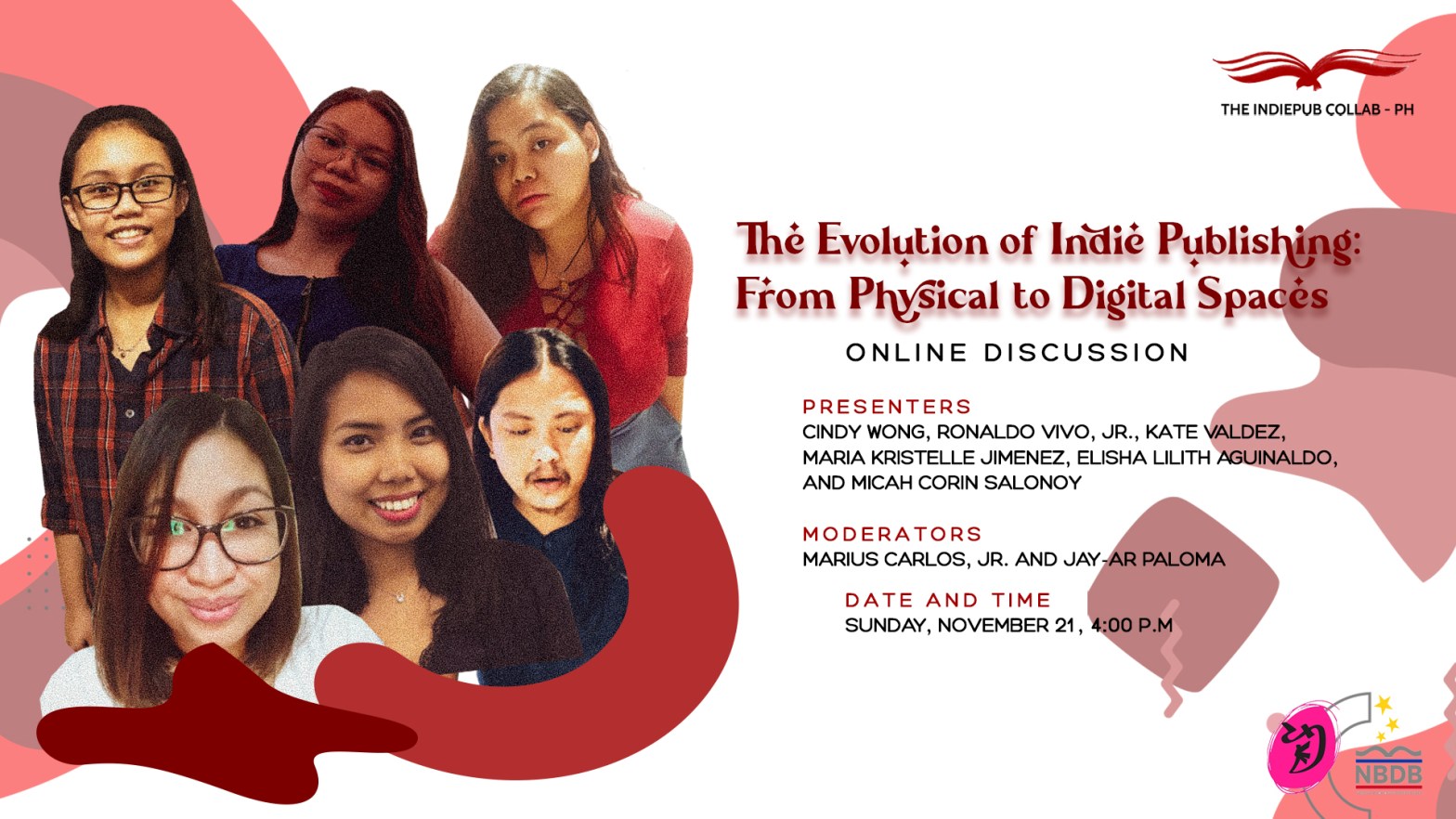
For the third day of INDIEPUBCON 2021, TIPC-PH publications 8letters, Rebo Press, and Vox Populi PH will examine how indie publishing has changed over time, from tangible books to the digital realm. The conference will also cover the benefits of independent publishing as well as how communities may be imitated and altered to improve the Philippine literary scene.

Cindy Wong of 8letters will speak about the physical component of independent publishing. Ronaldo Vivo, Jr. of UNGAZ PRESS and Kate Velez of LitArt Hub Publishing will provide additional insights into the physical printing landscape.

In addition, Rebo Press’ Maria Kristelle Jimenez will speak about the current state of digital publishing and the emergence of digital publications in the Philippines. Micah Corin A. Salonoy and Elisha Lilith S. Aguinaldo of Vox Populi PH will discuss the terrains of contemporary youth literature. This will be moderated by Jay-ar G. Paloma and Marius D. Carlos, Jr. 

“The Evolution of Indie Publishing: From Physical to Digital Spaces” will be a recorded discussion and can be viewed via TIPC-PH’s Facebook Page and YouTube channel on Sunday, November 21, at 4:00 p.m. The event will be followed by a Q&A portion, and is expected to be a lively and insightful meeting-of-the-minds between indie professionals and aspirants.

Anyone interested to join the forum can read about the registration process here.

This event is made possible by the National Book Development Board. Vox Populi PH is the official media partner for INDIEPUBCON 2021.